
Juvenile Center Release Destinations
The Berrien County Juvenile Center is a court-operated youth facility under the Family Division of the Berrien County Trial Court. Its Secure Detention Unit is not an adult jail. A youth leaves only with court authorization, and the next step depends on the order and the services or placement selected for that case. Public adult booking assumptions do not fit this setting.
The county describes several possible dispositions after adjudication. A youth may return to the community with probation and programs. The order may call for foster placement, commitment to the Michigan Department of Health and Human Services for placement, private residential treatment, or another disposition. A youth may also move to another jurisdiction. Therefore, “released from secure detention” describes an exit from that unit, not necessarily a return home, an end to court oversight, or a public release event.
The signed order should be read for both authority and destination. A date showing when secure detention ended answers only the first part of the question. The placement language shows whether the youth went home, entered treatment, moved into foster care, or remained under another agency’s control. Probation may continue after a return home. Services may also continue without secure detention. These details prevent a unit exit from being overstated as discharge from the whole juvenile case.
| Possible next step | What the exit means | Controlling source |
|---|---|---|
| Home with probation | Secure detention ended while court supervision and services continue. | Family Division order and probation record |
| Foster placement | The youth moved to an authorized care setting. | Court order and authorized placement records |
| MDHHS placement | The court committed the youth for an agency placement decision. | Court and MDHHS records available to authorized parties |
| Residential treatment | Custody at secure detention ended, but structured placement continues. | Court order and treatment placement |
| Other jurisdiction | Responsibility moved rather than ended. | Sending order and receiving jurisdiction |
Those distinctions protect accuracy and the youth’s privacy. A move from one program to another should never be described as a public community release without support from the order.
Confirm a Juvenile Center Release
The Family Division order is the main release authority. The Berrien adult Inmate Lookup Tool is not the right route and must not be used as though it covers juveniles. The county expressly states that youth identities are confidential unless disclosure is authorized by court order, statute, or a valid release. A parent, guardian, attorney, or other authorized person should work through the court or Juvenile Center and be ready to establish authority to receive information.
- Identify the exact Berrien juvenile matter and the relationship that authorizes access. Do not place a youth’s identity into an adult public-roster workflow.
- Review the most recent Family Division order. Look for the authorized date, destination, probation terms, services, or placement direction.
- Contact Berrien County Juvenile Center or the Family Division using the case information and any proof of authority the office requests.
- Ask a narrow question about the order or authorized placement. Staff cannot disclose confidential youth information merely because someone supplies a name.
- If responsibility moved to another agency or jurisdiction, follow the court order to the receiving contact instead of calling the move a completed community release.
The general Berrien County released inmates lookup applies to adult county, state, federal, and immigration systems. It does not override the Juvenile Center’s confidentiality boundary.
Juvenile Center Records Contact
The Berrien County Juvenile Center is located in Berrien Center and can route an authorized person to the correct Family Division function. The published phone is useful for procedural questions. It is not an invitation to seek a youth’s status without authorization. Use the case number and the court order when available, and avoid sending sensitive details through an unapproved channel.
Berrien County Juvenile Center
6414 Deans Hill Road
Berrien Center, MI 49102
269-471-2831
Master Control extension 4230
Family Division, Berrien County Trial Court
The court can explain what identification, consent, order, or other authority is needed for a record request. Public Michigan FOIA concepts do not turn confidential juvenile material into an adult booking record. Michigan juvenile law in Chapter 712A supplies separate confidentiality and set-aside provisions. The office should decide whether a requested item is public, confidential, redacted, or available only to an authorized party.
A useful request names the specific existing order or authorized record. It should not ask staff to create a public release history or confirm a youth to a casual caller. If a lawyer, parent, guardian, or case professional needs proof that secure detention ended, the signed order and the authorized court file are stronger than an informal statement.
Keep the request tied to the youth’s own case and the requester’s legal role. A parent may need different proof than an attorney or agency worker. The Juvenile Center can explain the proper intake channel, but published contact information does not waive confidentiality. Do not send a youth’s name, birth date, placement, or case facts to an unrelated adult locator. The goal is to obtain the existing authorized record from its custodian while limiting disclosure to the people whom the law or court order permits.
Note: The controlling release document is the court order, even when a youth physically leaves the Secure Detention Unit for another program.
Juvenile Center Release Statistics
The overall Berrien County Juvenile Center program has 42 beds across three functions. Secure detention has 16 beds. The Alternative Detention Program has eight, while residential treatment and family services have 18. These functions should not be merged into one public custody category. Secure detention is the unit addressed here, and a move into another center program can be a placement change rather than a community release.
The county’s 2025 secure-detention statistics report 85 admissions, an average daily population of nine, 3,859 service days, 66 percent capacity, and an average age of 15.9. Admissions are not releases. The figures describe program use and duration, not a list of named youth or a count of community returns. They also do not predict how long any one youth will stay because the court controls the disposition.
Service days count days of care across the unit, while average daily population describes typical use over time. Neither measure supplies a release date. The reported average stay of 41 days is also a group measure, not a deadline for an individual case. An authorized person must still read that youth’s latest order. Using an average to forecast a named youth’s move would ignore court decisions, placement availability, and the distinct facts of the juvenile matter.
Unlike an adult jail sentence with a public Release Date field, a secure-detention stay depends on court action and the individual juvenile case. No adult IML record, MDOC OTIS date, or BOP result substitutes for that court authority. The careful question is not simply whether the youth “got out,” but which placement or supervision status the judge authorized next.
Note: Published secure-detention averages describe the unit as a whole and do not predict a release date for any youth.
Juvenile Center Release Confidentiality
Berrien County’s Juvenile Center overview states that youth identities are confidential unless a court order, statute, or valid release permits disclosure. That rule changes how every search and records question must be handled. A public adult roster can display booking data because it serves a different system. Secure-detention information requires a legal basis tied to the juvenile matter.
- Court authorization
- The judicial permission required before a youth leaves secure detention or moves to a stated placement.
- Disposition
- The court’s ordered outcome, which can include probation, care, treatment, or another placement.
- Confidential record
- Information withheld from general public access and released only when law or an order permits.
- Authorized party
- A person or entity with a recognized legal basis to receive case information.
A negative adult search has no meaning here. It does not show that the youth was released, never detained, transferred, or returned home. Likewise, public discussion should not pair a youth’s name with detention claims. The proper path is direct, private, and case-based: establish authority, read the latest order, and ask the Family Division for the record that lawfully answers the question.
Juvenile Center Release Source
The county’s official Secure Detention page explains that court action controls release and lists the range of possible dispositions.
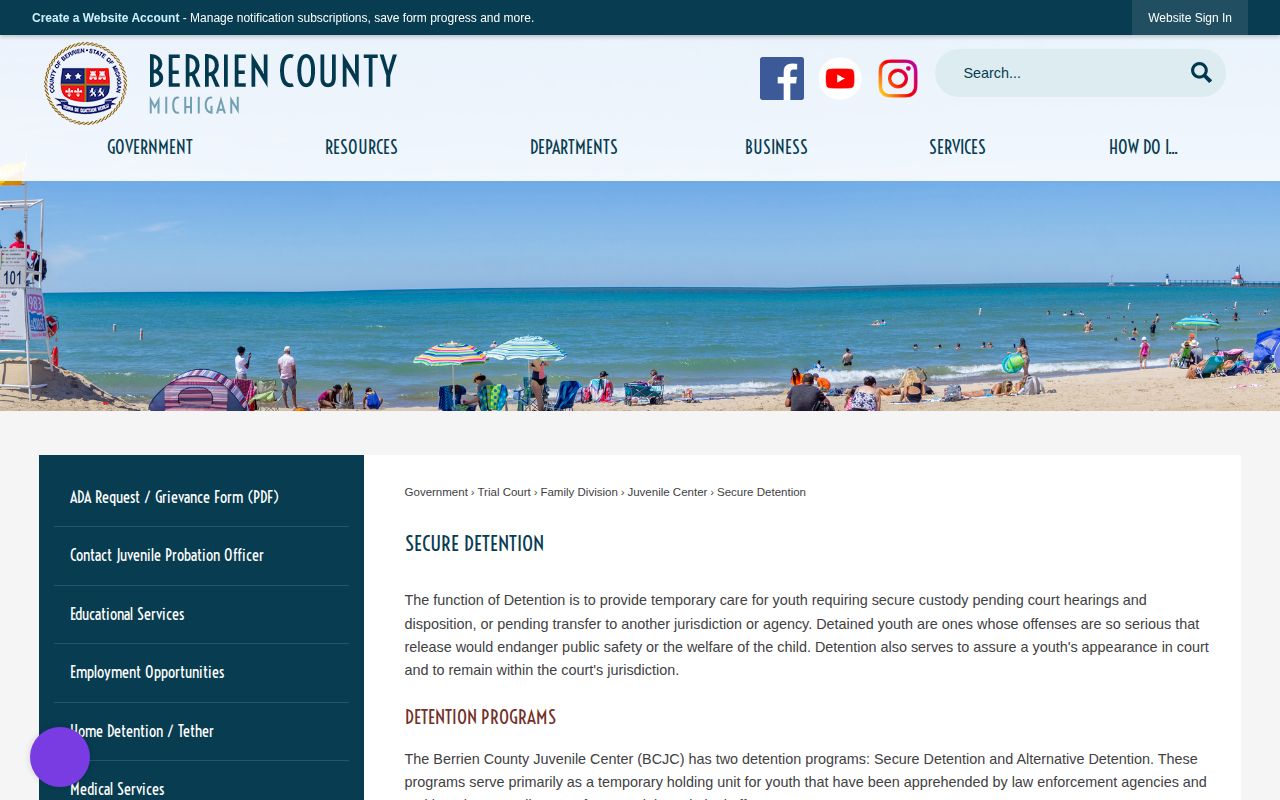
The official page supports a placement-based reading of release and does not create a public roster of youth.